What is financial shared service center?
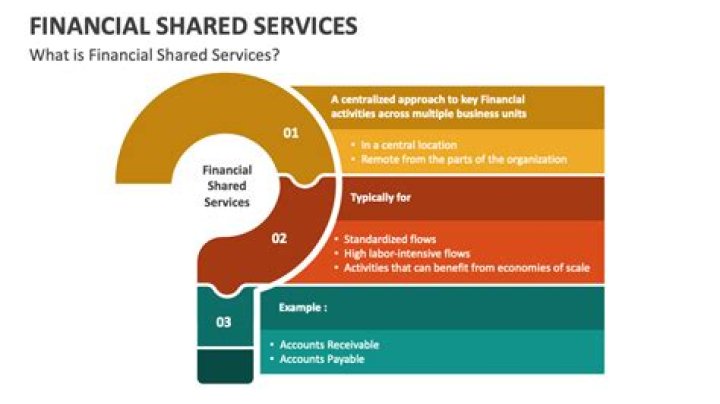
Rather, a financial shared services center serves as an independent service provider within an organization. As independent service providers, SSCs are funded by user fees according to contractual agreements with the other business units in their organizations.
How does a shared service center work?
A shared service is an accountable entity within a multi-unit organization tasked with supplying the business unit, respective divisions and departments with specialized services (finance, HR transactions, IT services, facilities, logistics, sales transactions) on the basis of a service level agreement (SLA) with a …
What are the benefits of shared service center?
Shared Service Centers reduce service duplication and business unit silos within organizations by integrating service functions into a single department. This prevents knowledge silos from developing within business units and ensures that knowledge generated through service delivery can benefit the entire organization.
How do I set up a shared service center?
The following five steps could be taken as guidelines for companies that are considering establishing any type of shared service organisation:
- Clearly Define the Strategy.
- Communicate to the Stakeholders.
- Make the Best Use of Technology.
- Make it a Centre of Excellence.
- Plan for the Future.
What shared services example?
Services that can be shared among the various business units of a company include finance, purchasing, inventory, payroll, hiring, and information technology. For example, a central headquarters might control all the hiring for an entire chain of retail stores.
What is a shared service role?
Shared services is the consolidation of business operations that are used by multiple parts of the same organization. The goal of a shared services delivery model is to allow each business division to focus its limited resources on activities that support the division’s business goals.
Why do shared services fail?
There may be good reasons for this that could potentially be addressed, such as poor leadership or an inadequate communication plan with key stakeholders; but unaddressed, an obstructive culture can result in a failing shared services operation or, at the very least, an operation that does not achieve all it could.
What are the cons of it shared services?
The cons
- Risk of non-compliance. How do you make sure the SSC remains compliant with local rules in all the countries in which your business operates?
- The lack of local know-how. Local accounting and tax rules differ from country to country.
- The lack of local relationships.
What are 2 examples of sharing services?
Examples of the Sharing Economy
- Peer-to-Peer Lending.
- Crowdfunding.
- Apartment/House Renting and Couchsurfing.
- Ridesharing and Carsharing.
- Coworking.
- Reselling and Trading.
- Knowledge and Talent-Sharing.
- Niche Services.
What are examples of shared services?
How do you manage shared services?
10 tips for implementing shared services
- Create a road map. Get buy-in from senior management.
- Invest in change management.
- Don’t bank all your savings.
- Fix processes.
- Design the retained organization.
- Don’t increase the number of handoffs.
- Focus on risk management.
- Move quickly.
What is shared service in HR?
Simply put, HR Shared Services is a strategic way to provide HR-related services to an ever-growing employee base. And it comes with some advantages such as continuity and efficiency. Here are seven advantages to following this type of strategy. Consolidate HR tasks and software.
What is an example of sharing service?
Human Resources. Business capabilities such as human resources are commonly run as a shared service. This allows an organization to manage risks such as legal or compliance risks from one center of competency.
What is shared services in simple terms?
Shared services or shared services center (SSC) refers to a dedicated unit (including people, processes and technologies) that is structured as a centralized point of service and is focused on defined business functions.
Why is HR shared services model?
Organisations use shared services as a way of organising their HR activities, typically concentrating administrative activities into a centralised ‘hub’. The shared service model can help businesses reduce costs, avoid duplication of effort, and allow a greater focus on HR strategy.
What is included in shared services?
Services that can be shared among the various business units of a company include finance, purchasing, inventory, payroll, hiring, and information technology. The term “shared services” can also apply to partnerships formed between separate businesses.
What is a shared service delivery model in HR?
Imagine a large company with some 200,000+ employees spread across 6 different subsidiaries. Instead of each subsidiary having an HR department of its own, under a shared services model the HR department serves as HR for every individual entity that falls under the overall business umbrella.
What does a shared service center do?
“Shared services” is the now well-established principle of consolidating “non-core” (back office) support services, and delivering these from centralized locations to provide lower costs, higher quality/reliability, standardization and harmonization of processes, and a flexible services delivery platform from which to …
How does a shared services model work?
The shared services model is designed to provide services to “customers” — internal stakeholders, business-unit leaders and functional heads. The SSO typically operates like a business, with a defined set of services and pricing structure.
What is the difference between BPO and shared services?
BPO is the process of engaging a third-party vendor with the right skills and resources, to carry out work on your behalf. Shared Services relates to the creation of an autonomous business unit, based on-site, which carries out these processes for multiple functions within an organisation (HR, Finance, procurement).
How do you implement a shared service center?
What are the benefits of shared services?
Why do Shared Services fail?
Is shared services under BPO?
While shared services are an internal function, BPOs are external vendors. Both can serve multiple business units, and both have their advantages and disadvantages.
When should a company use shared services?
Where are the finance shared services centres located?
“We must have done something right,” says the Asia Pacific CFO of Regus, a global provider of business centre office space that had revenues of US$1.9 billion in 2011. Finance and accounting processes that used to be done in Belfast and Dallas have been moved to Manila, as have IT services.
What does shared services mean in accounting and finance?
Centralization, or shared services, enables businesses to implement a standard or uniform off-the-shelf software package that can be used by all of their site locations. It creates a standard global chart of accounts, implements standard global processes, and offers centrally controlled procurement, as well as shared services.
What are the advantages of a shared service centre?
It creates a standard global chart of accounts, implements standard global processes, and offers centrally controlled procurement, as well as shared services. Another key advantage is the added degree of control available to the operating user at the shared service centre.
When did John Henderson set up finance shared services centre?
When John Henderson embarked on a project to set up a shared services facility for regional finance and accounting in Manila three years ago, he did not expect it to become the 500-strong global centre it is today.